
ClearTrack
Permitting System
Designing the unified tool my team was never given, built from 9 years inside one of the Southeast's largest HVAC operations.
Projected outcomes are estimates based on identified operational friction points and workflow analysis. This is a self-initiated concept, not a deployed product.
9 years inside the problem before designing the solution
Morris-Jenkins is one of the Southeast's most respected HVAC, plumbing, and electrical companies, open 365 days a year, 6am to midnight, with 25,000+ five-star reviews and a legacy stretching back to 1958. During peak season, our permitting team processes up to 25 installations per day across Charlotte and Greenville, each requiring a permit from one of 20+ municipalities with their own unique rules, portals, timelines, and inspectors.
I joined Morris-Jenkins in 2017. For nearly five years as Install Coordinator and SME, I lived this process from the inside, coordinating with crews, inspectors, county offices, utility companies, homeowners, and stakeholders simultaneously. I also led the company's platform migration efforts twice, working directly with developers across two different teams to try to fix the tools we were using.
ClearTrack is what I designed when I stopped waiting for someone else to solve it.
Two attempts. Three platforms. One coordinator in the middle.
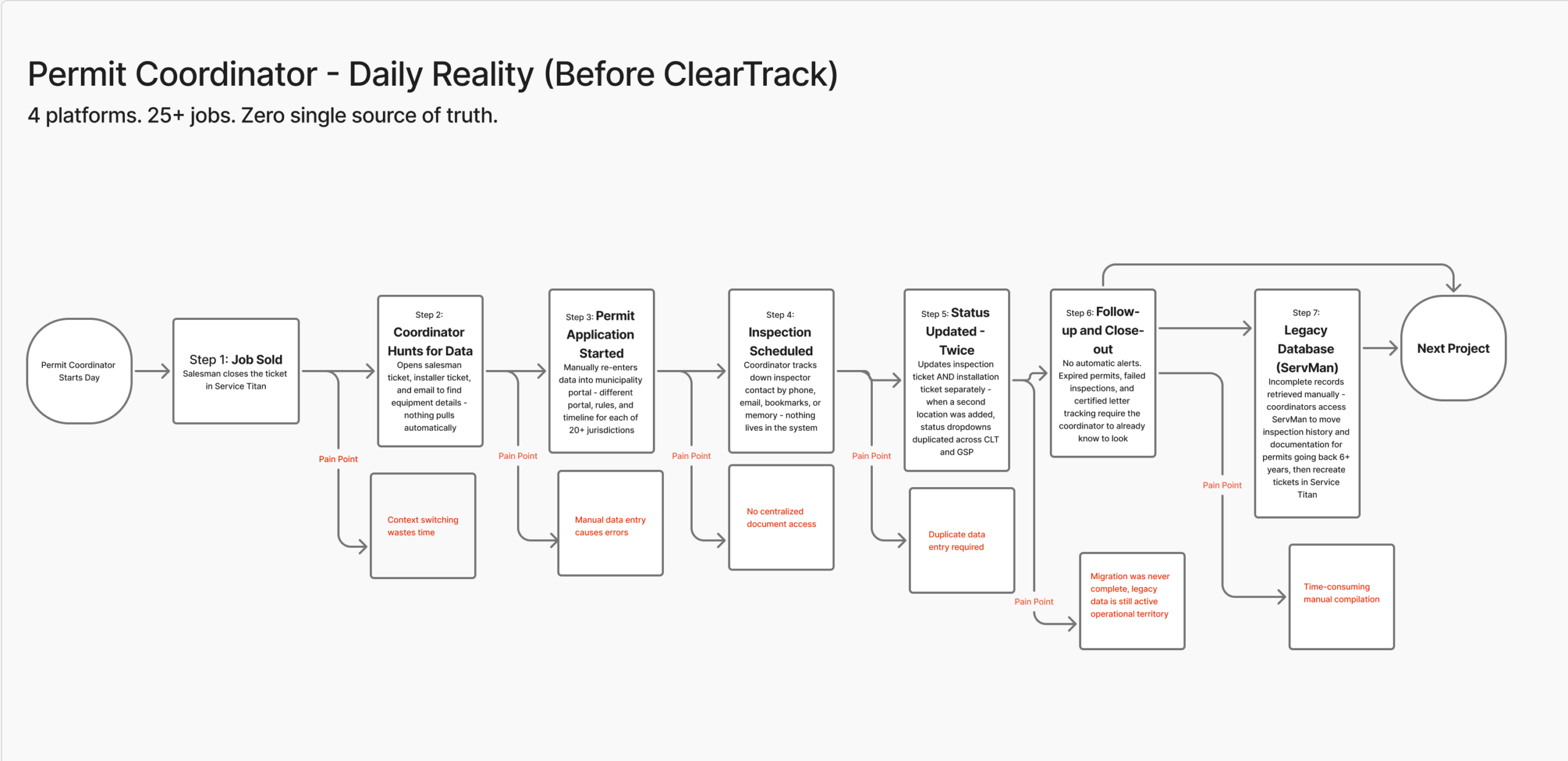
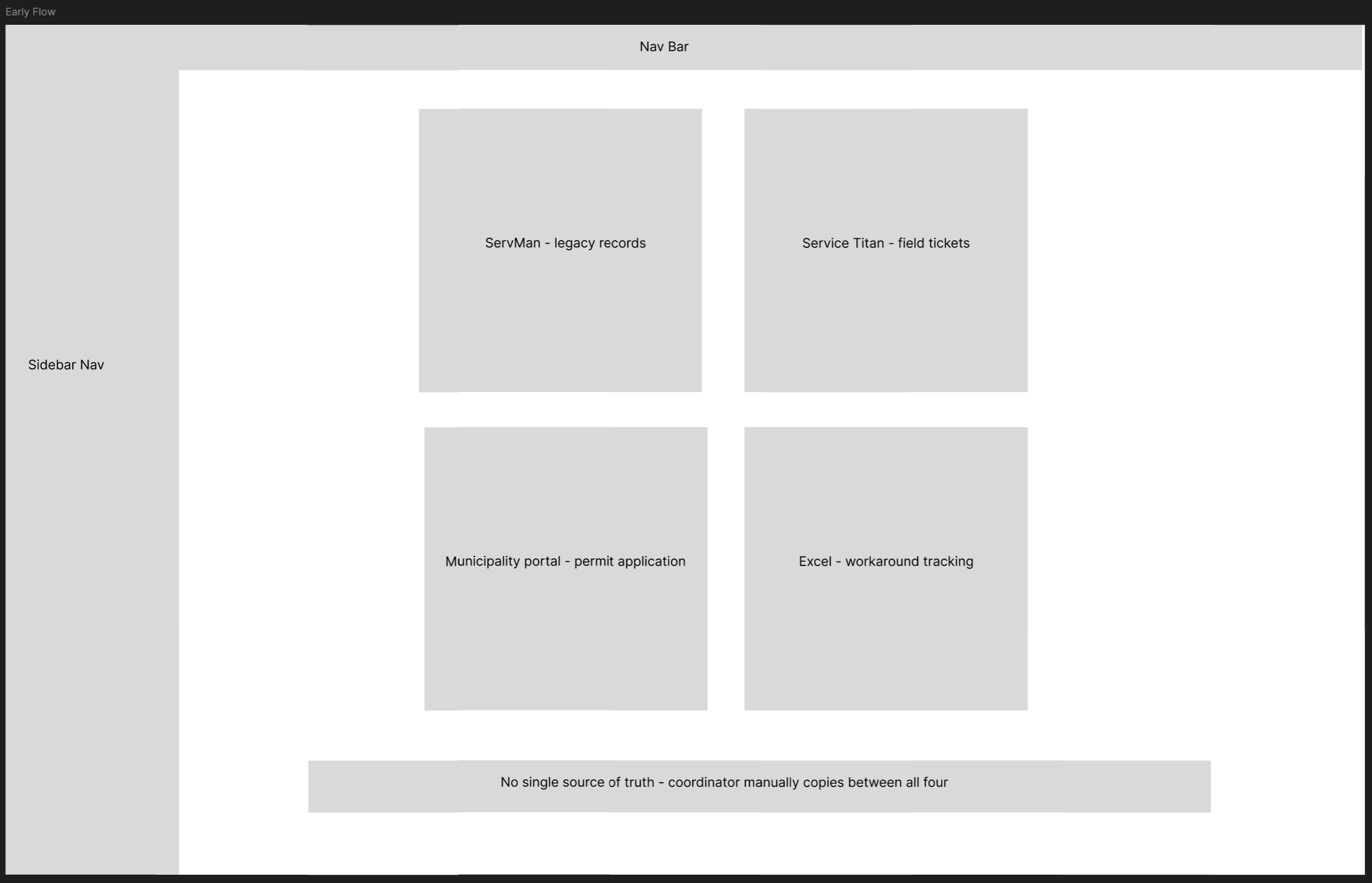
Before ClearTrack, our team managed permits across a patchwork of systems that were never designed to work together. At peak, we were toggling between four platforms simultaneously just to schedule a single inspection.
When we transitioned from ServMan to Service Titan, a custom tool called Wrench Connect was built specifically for our permitting team, and I was the SME on that project. I worked on-site with project managers, stakeholders, and a development team to shape the platform. Despite months of effort and significant investment, Wrench Connect was never stable. Fixing one issue routinely broke two others. Of 1,067 permitting records, only 898 imported successfully. The other 167 required manual entry.
"Fix one thing, break two things. We got our hopes up twice and were let down twice. That history lives in any new platform you try to introduce."
A second development team came in: local, English-speaking, and genuinely curious about our workflow. They visited our office, observed how we worked, and returned with Figma wireframes that actually reflected our needs. For the first time, someone understood what we were asking for. But a March 7, 2024 launch deadline forced stakeholders to move forward with Service Titan instead, leaving us with a platform that improved document grouping but still couldn't be customized for how a permit coordinator actually thinks and works.
Five specific failure points, not just "the tools were bad"
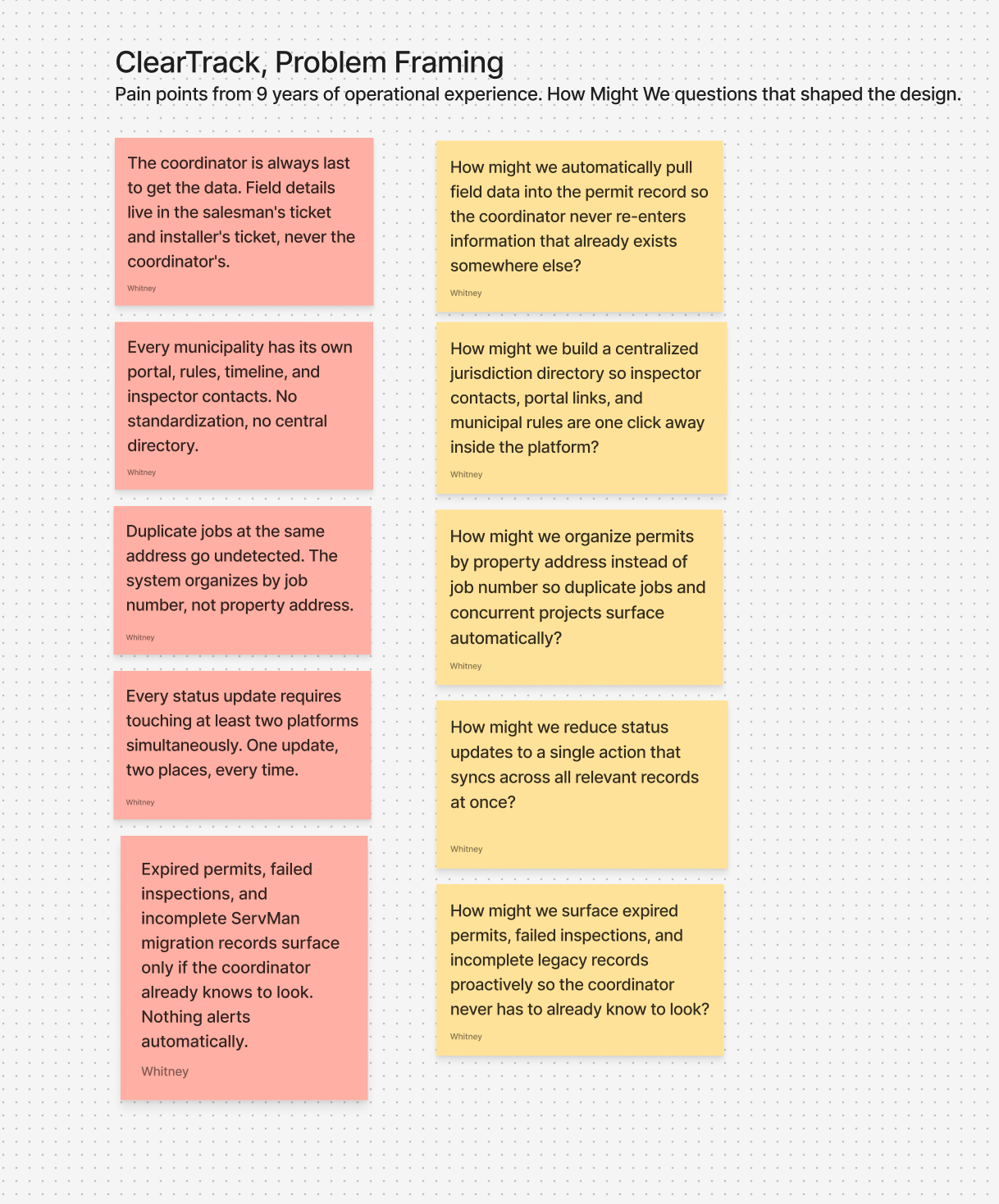
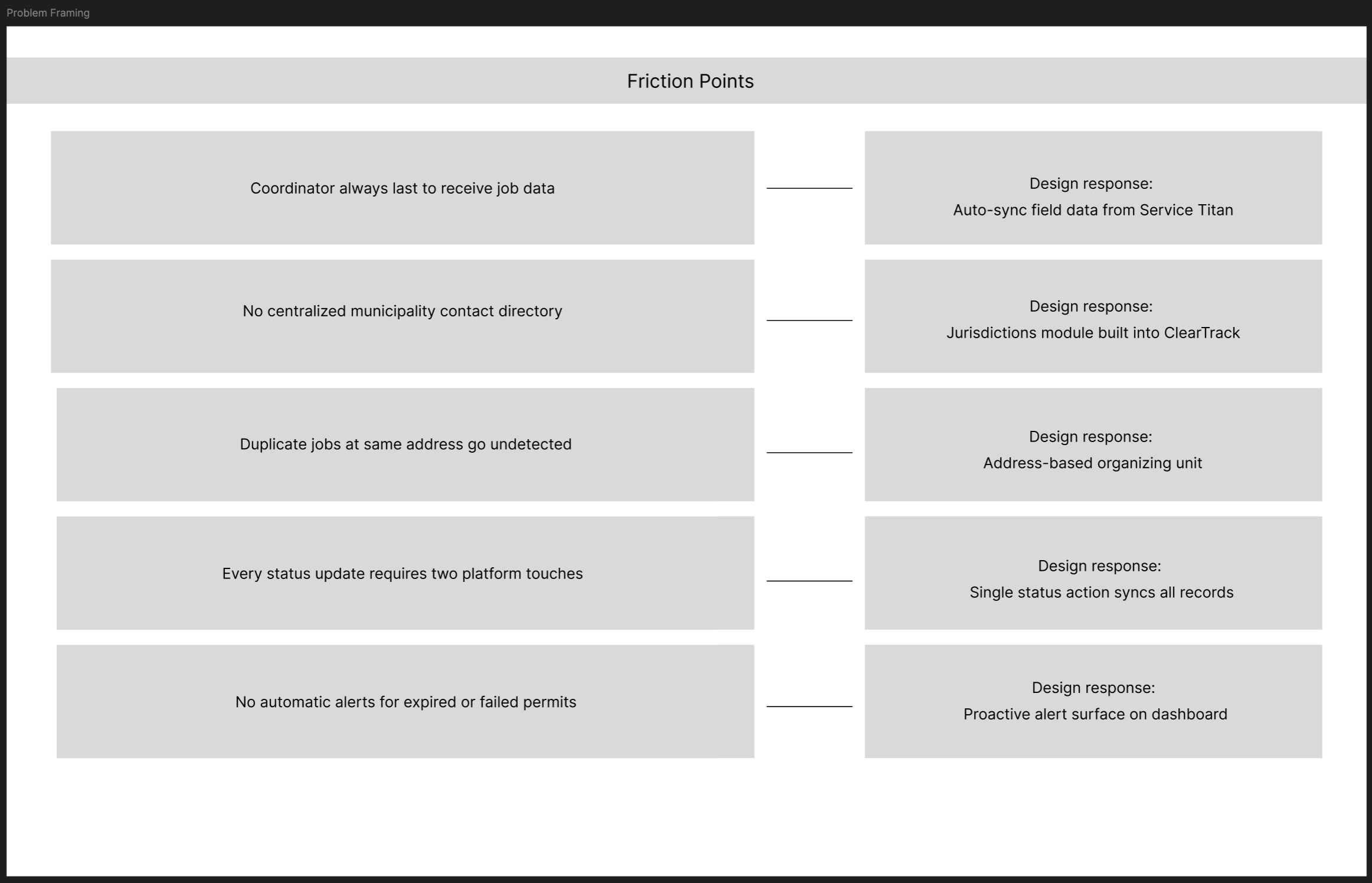
The problem wasn't vague. It was five distinct friction points that compounded each other every single day.
Mapping the problem before designing the solution
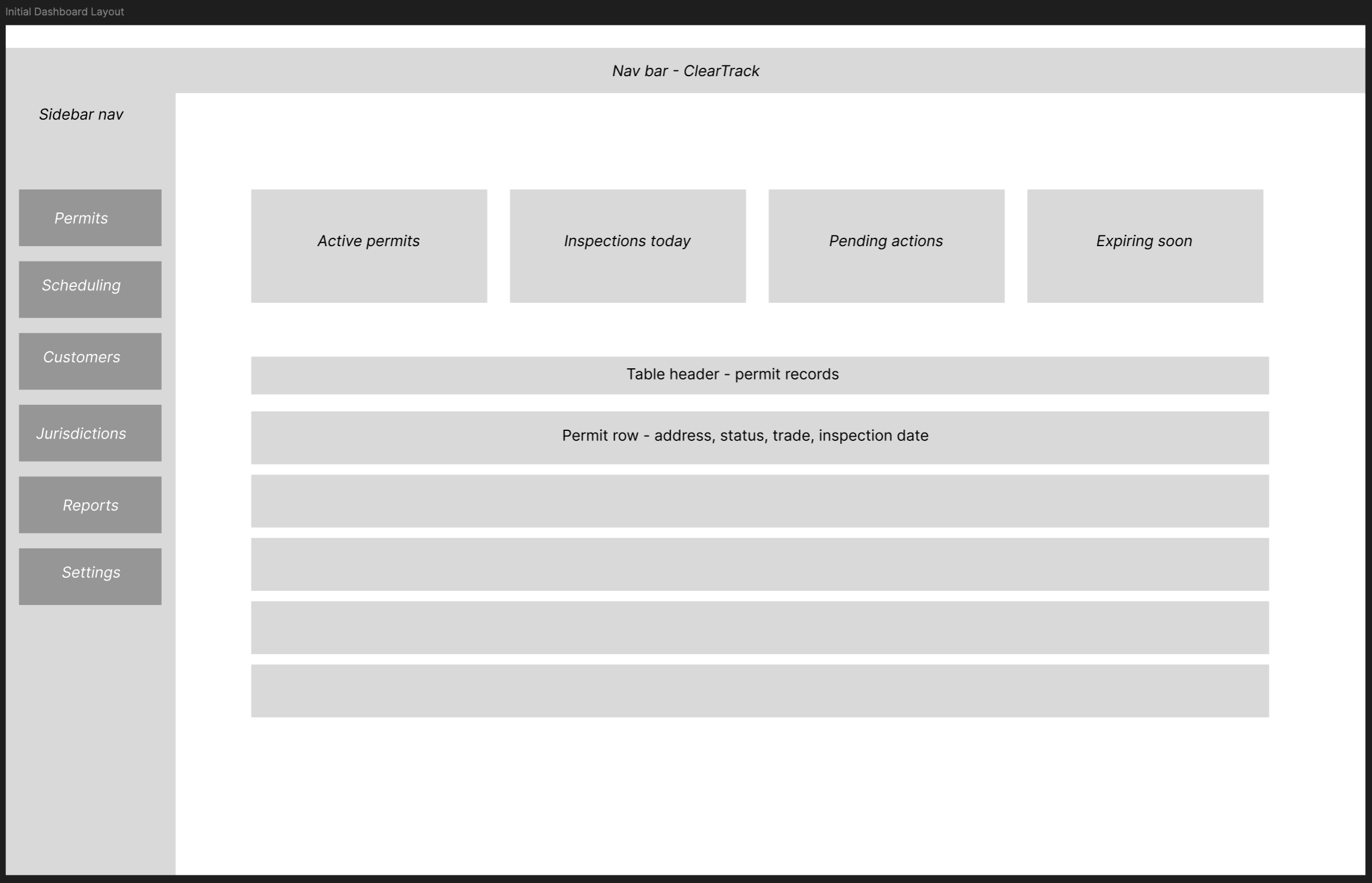
Before opening Figma for the final UI, I mapped the coordinator's broken daily workflow, framed the core problems as design questions, and sketched the initial dashboard structure in greyscale. These artifacts show the thinking that happened between identifying the friction and committing to a design direction.
Three decisions, and why I made them in that order
The coordinator's most repetitive failure point was the starting point: re-entering field data that already existed somewhere else. I designed the Technician Completion Form to pull automatically from the installer's Service Titan ticket via API, pulling equipment type, install location, inspection dates, and ladder requirements directly into the ClearTrack permit record.
Every platform organized around job numbers or ticket IDs, logical from a database perspective, but wrong for a permit coordinator. "What's happening at 4312 Meadow Lane?" is the real question, not "What's the status of job #J0297576?" ClearTrack groups all permits, inspection history, and documents under the address, so everything related to a property is visible in one view, including multiple concurrent projects invisible in Service Titan.
Inspector names, phone numbers, portal links, GIS links, and custom notes, scoped to the coordinator's region, accessible without leaving ClearTrack. When a failed inspection happens and a crew needs an inspector's direct number immediately, the answer is one click away. I also designed region-specific views so Charlotte and Greenville data stay cleanly separated, with architecture to scale across additional Wrench Group locations.
What I deliberately left out
We frequently lose track of who originally called in a job: a family member or caregiver may have scheduled on the homeowner's behalf, and if their number wasn't saved, the permit tech has no way to reach them later. Automated inbound call logging could solve this.
I left it out. Logging call records without explicit consent frameworks raises privacy questions I'm not positioned to resolve at the design stage. The right answer might be a process prompt during scheduling, not surveillance infrastructure. I'd validate that assumption with real coordinators before building anything.
ServMan had a feature I genuinely miss: filtering customers with unscheduled inspections and sending mass outreach in one action. During slow periods, this generated a flood of callbacks and cleared backlog fast.
I left it out of initial scope because it adds real infrastructure complexity: sending systems, opt-out compliance, rate limiting. Getting the core platform right first was more important than building a powerful feature on an unstable foundation. This is a clear Phase 2 priority.
Honest reflection: what's still unfinished
What this project is really about
ClearTrack isn't a polished client deliverable. It's what happens when someone with deep domain expertise finally has the tools to articulate what the right solution looks like.
I wasn't the developer who built Wrench Connect. I wasn't the stakeholder who decided to move to Service Titan. I was the coordinator in the middle, the one who imported 898 permit records by hand, held meetings with developers across multiple time zones trying to explain what "easier" actually meant, and built the Excel workarounds that kept the operation running while the real platforms were failing.
ClearTrack is my attempt to show, to myself and to anyone hiring, that I understand this problem from the inside. Not just the interface, but the workflow underneath it. Not just the features, but why each one earns its place.
Want to talk about this work?
Open to product designer roles at teams building operational tools, civic tech, and enterprise platforms where design has to earn its place.