

Project details
- Project Name: Research & Discovery Practice
- Author: Whitney Cullens
- Description: Making sense of complexity through thoughtful research, observation, and synthesis to inform clearer decisions.
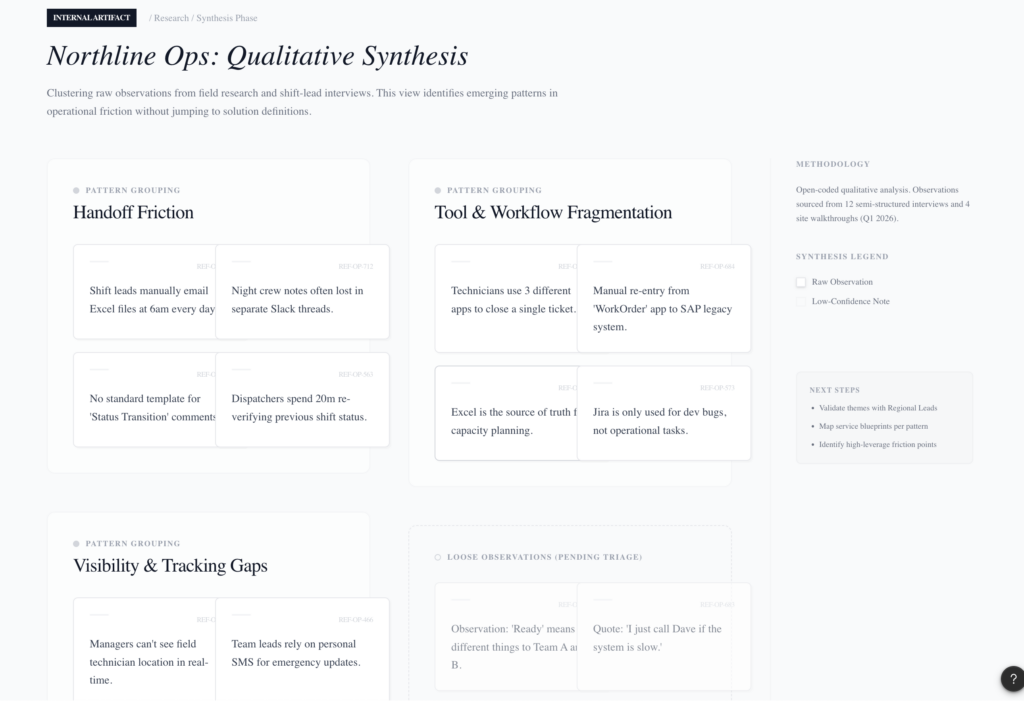
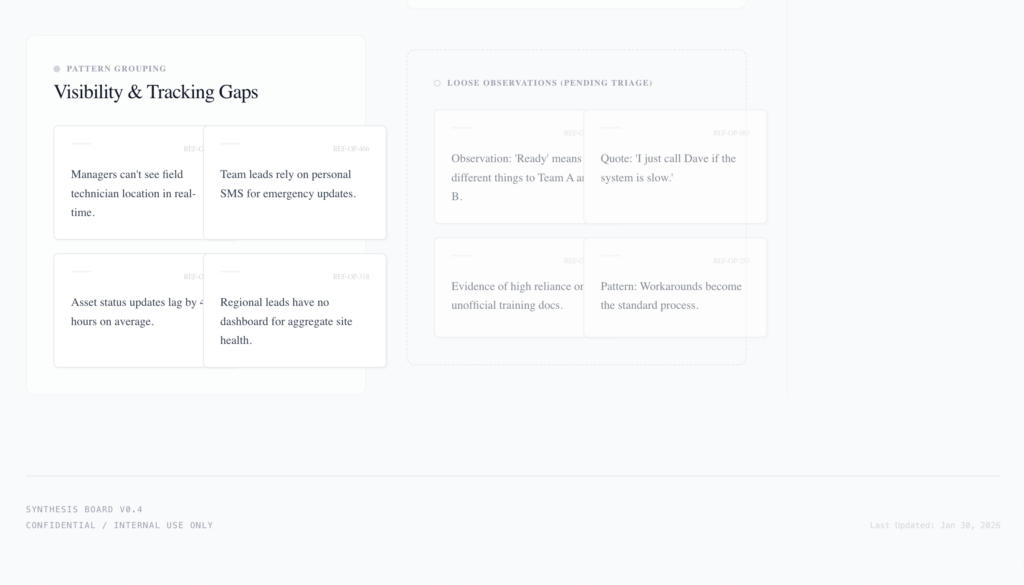
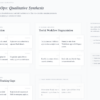
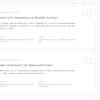
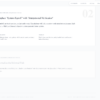
- 1–2. Research Synthesis Artifacts (Structured, Not Decorative): What you’re seeing: A qualitative synthesis board clustering raw field observations into recurring operational patterns — such as handoff friction, workflow fragmentation, and visibility gaps. Why it matters: This work avoids premature solutioning. Patterns are grounded in verbatim observations from interviews and site walkthroughs, ensuring insights remain traceable to lived experience rather than abstract assumptions.
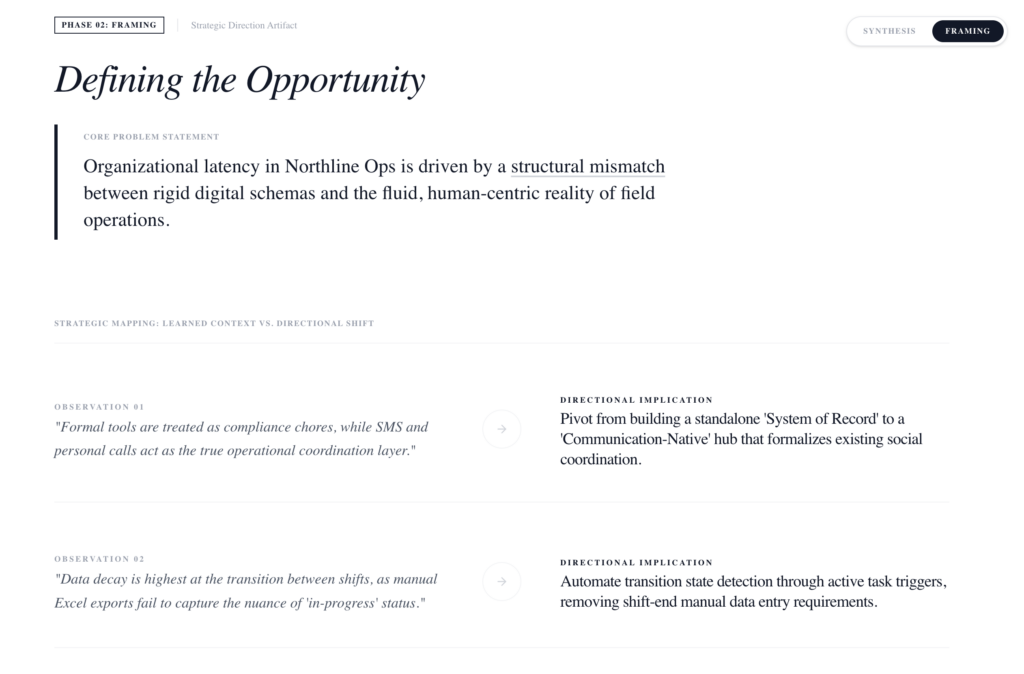
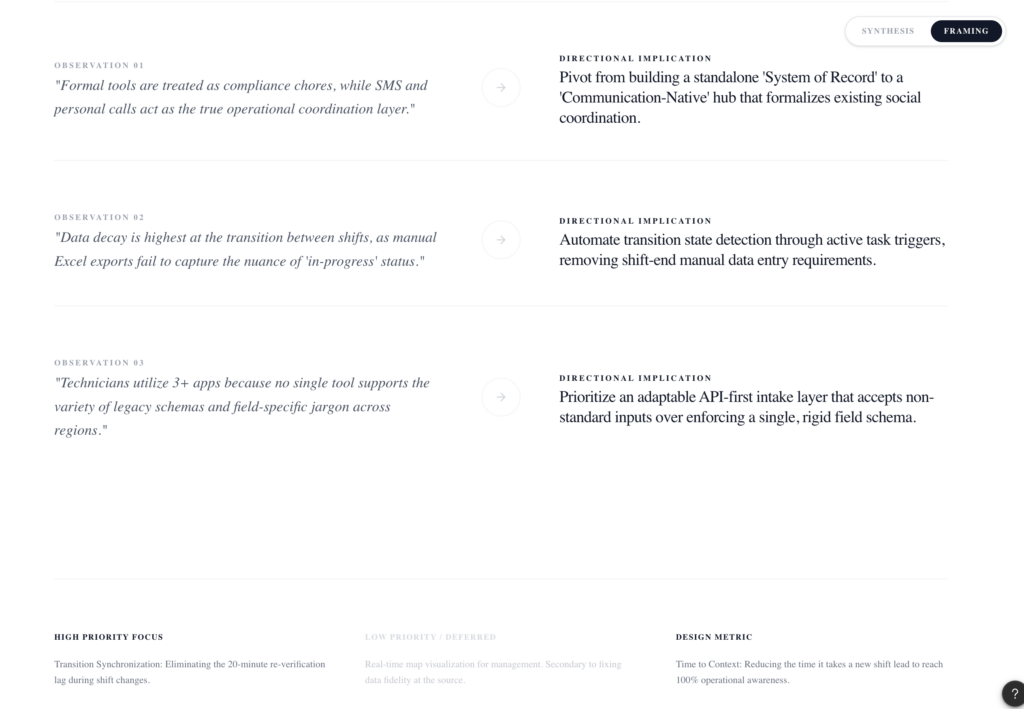
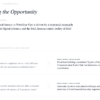
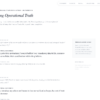
- 2–4. Insight Framing & Problem Definition: What you’re seeing: A formal reframing of the core problem facing Northline Ops: organizational latency caused by a mismatch between rigid digital schemas and fluid, human-centric field coordination. Each observation is paired with a directional implication, creating a direct bridge between research and product strategy. Why it matters: This framing establishes design constraints instead of feature ideas — allowing teams to align before building.
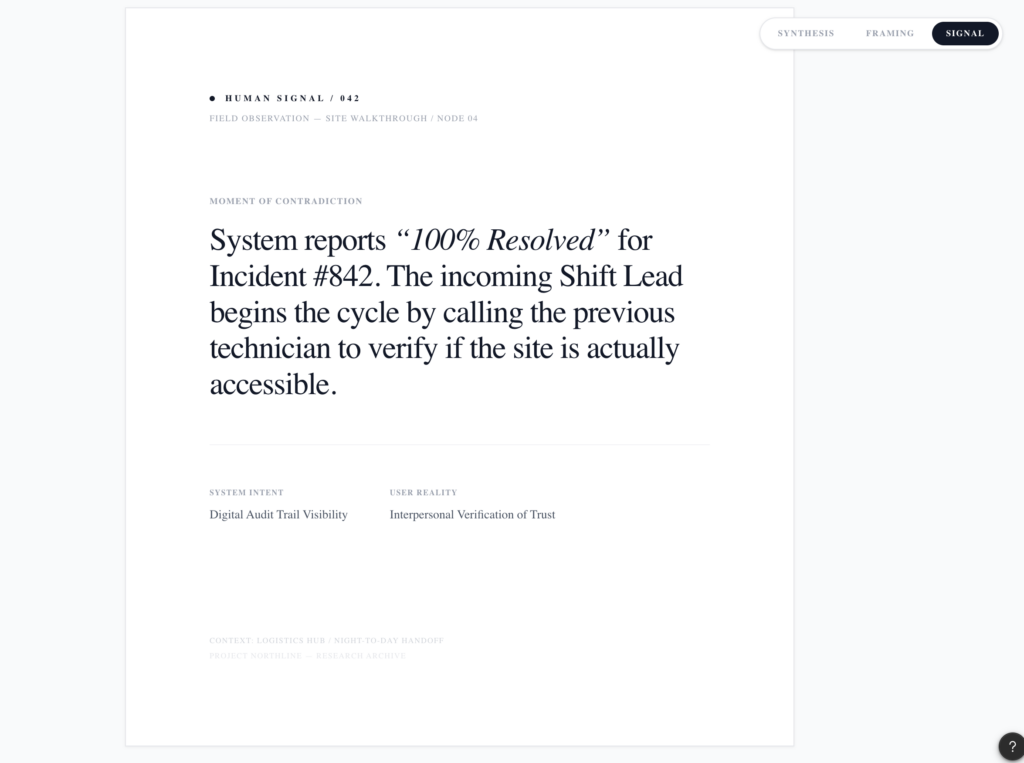
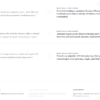
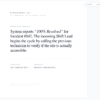
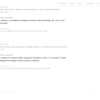
- 5. Human Signal (Restrained, Real): What you’re seeing: A single moment of contradiction where system-reported completion conflicts with human verification behavior. Why it matters: This artifact captures the gap between system intent and user trust. It grounds the research emotionally without becoming anecdotal or sentimental.
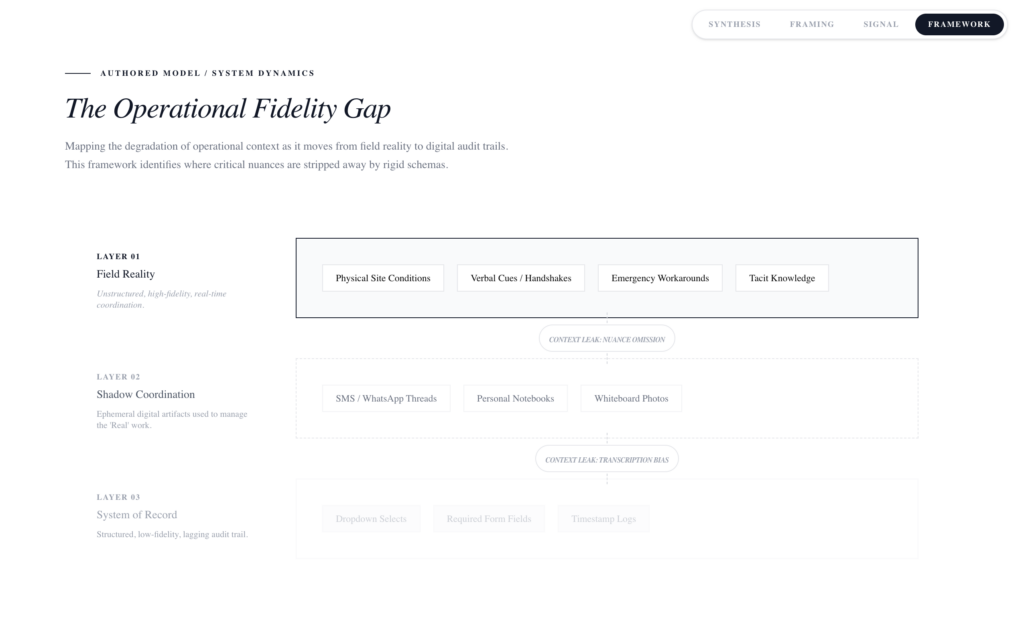
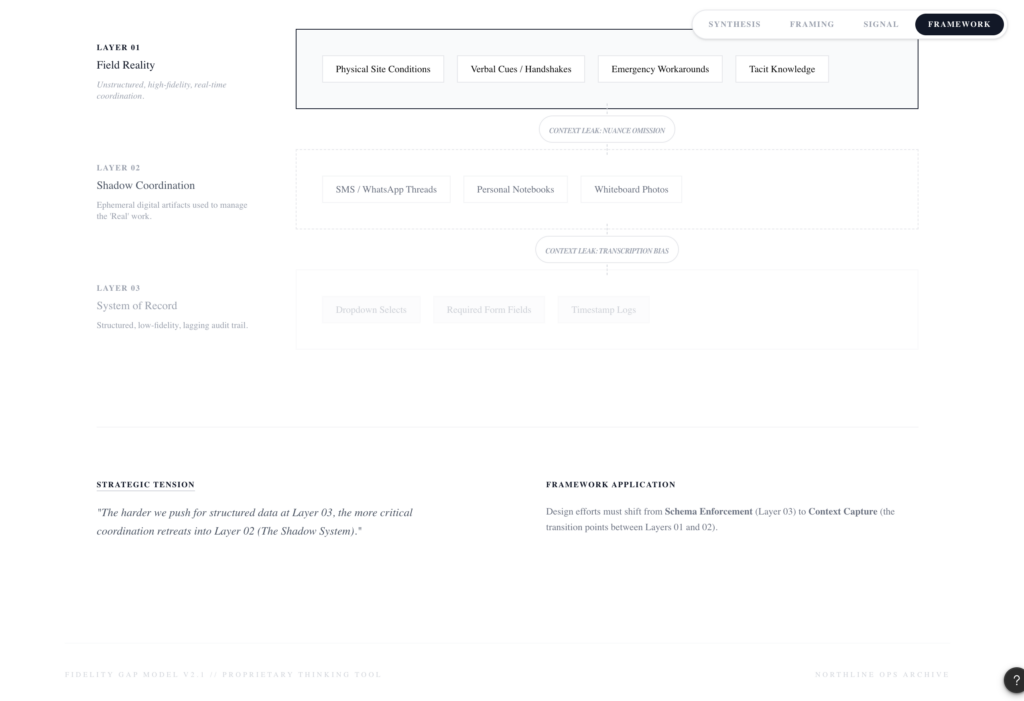
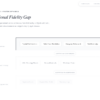
- 6–7. Authored Model / Framework: What you’re seeing: The Operational Fidelity Gap — a model mapping how context degrades across three layers: Field Reality Shadow Coordination System of Record The framework identifies where rigid schemas strip away critical nuance and where intervention is most effective. Why it matters: This model became a shared language across design, product, and engineering — aligning teams on where to design, not just what to design.
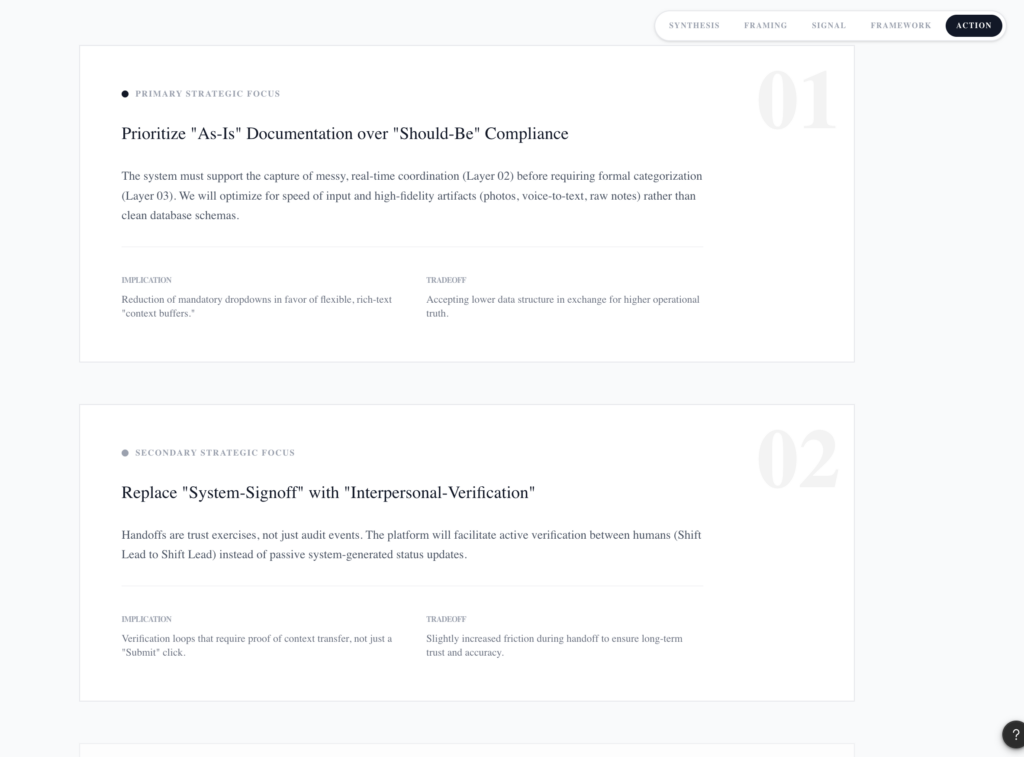
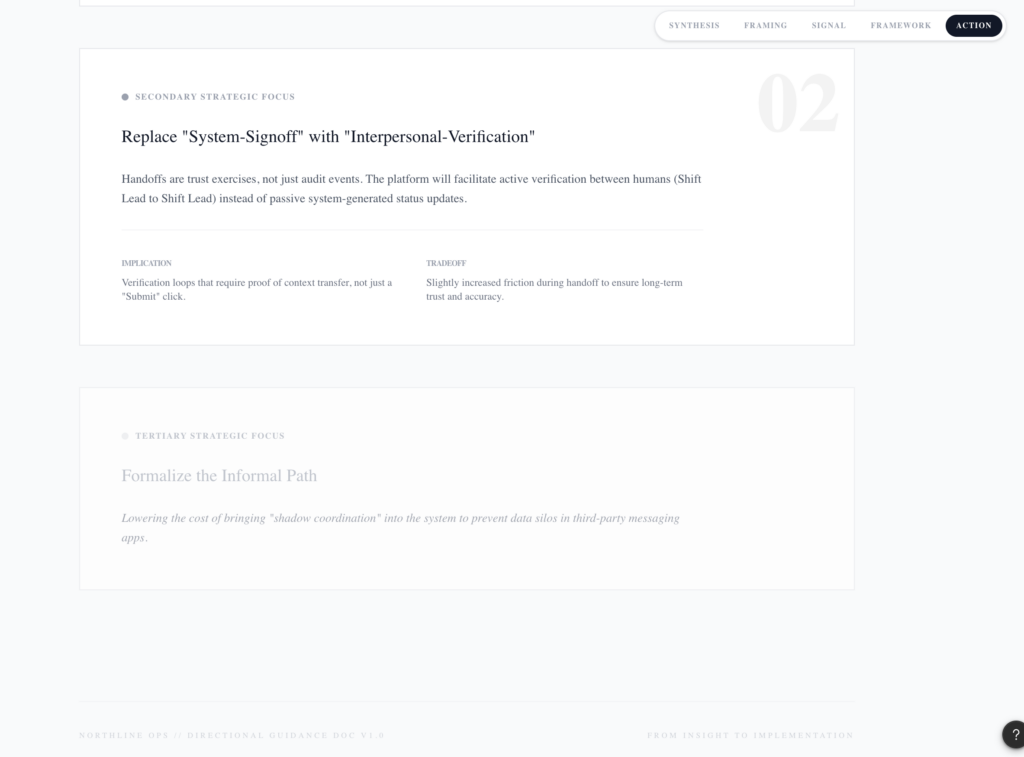
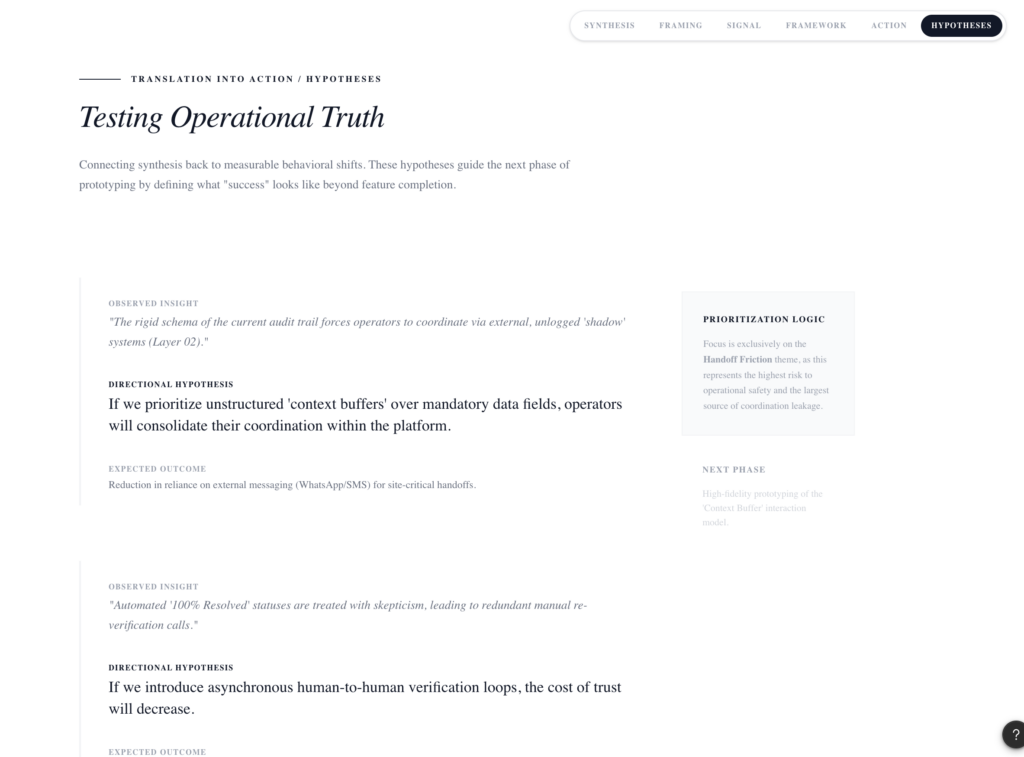
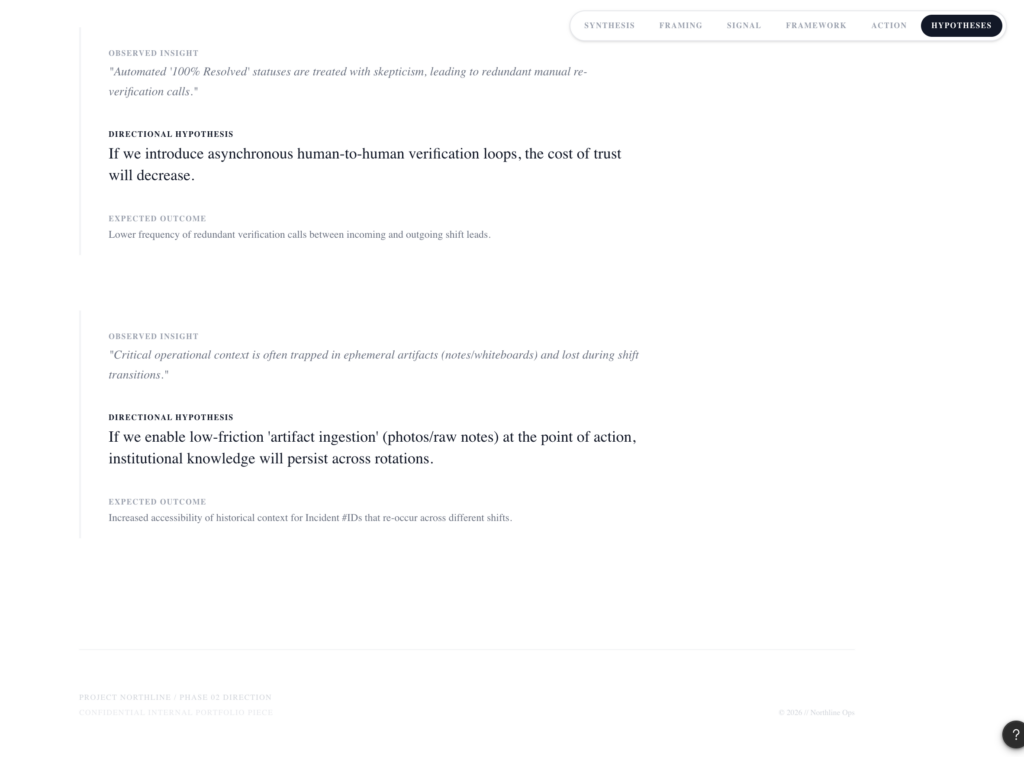
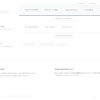
- 8–11. Translation Into Action: What you’re seeing: Strategic priorities and hypotheses derived directly from synthesis: Prioritizing “as-is” documentation over idealized compliance Replacing passive system sign-off with human verification loops Lowering the cost of capturing informal coordination inside the platform Each action is paired with explicit tradeoffs and success criteria. Why it matters: This is where research becomes operational — shaping roadmap decisions, not sitting in a deck.
Research & Discovery
Research & Discovery Practice
Northline Ops is an internal operational research initiative focused on understanding where real-world coordination breaks down inside complex field operations — and why traditional systems fail to capture operational truth.
This work documents how information decays as it moves from human context to rigid digital systems. Rather than jumping to solutions, the project emphasizes structured synthesis, problem framing, and authored models that translate messy human realities into actionable product direction.
The artifacts shown here reflect how I turn qualitative insight into clear strategic constraints, guiding design decisions long before interface work begins.
I enjoy the part of the work where things are still a little unclear.
Research and discovery are where I slow down, listen closely, and start making sense of complexity. This mightlook like gathering qualitative insights, reviewing patterns across touchpoints, or stepping back to understandthe broader context before jumping to solutions.
I’m less interested in research as a formal ceremony and more interested in what it reveals—the tensions, theunmet needs, the small signals that point to bigger opportunities. This is where assumptions get challenged anddirection begins to form.
Good discovery doesn’t rush answers. It creates shared understanding.