
A milestone birthday, broken escalators, and why good design is really just about handling failure gracefully
It’s my birthday. A milestone one. And you already know, a lady never tells. 😉
I’m back in Chicago. My city. The one that built me. Where the architecture makes you stop and just look up. Where the wind is pushy and doesn’t ask permission. Where Garrett’s popcorn hits you from half a block away and your feet just start moving toward it like you have no choice. And honestly, you don’t.
That Chicago. My Chicago.
I had a whole vision. And I need you to know, the vision was immaculate.
No rental car. No itinerary with time slots. A rooftop. Downtown. Blue Line. Red Line. Square cut pizza from Pat’s. Harold’s Chicken. A walk along the lake where the wind cools you in a way no AC has ever come close, and you remember what it feels like to be exactly where you’re supposed to be.
I was going to move through the city the way the city was built to be moved through. From the inside. Like I never left.
Honestly? I never really did.
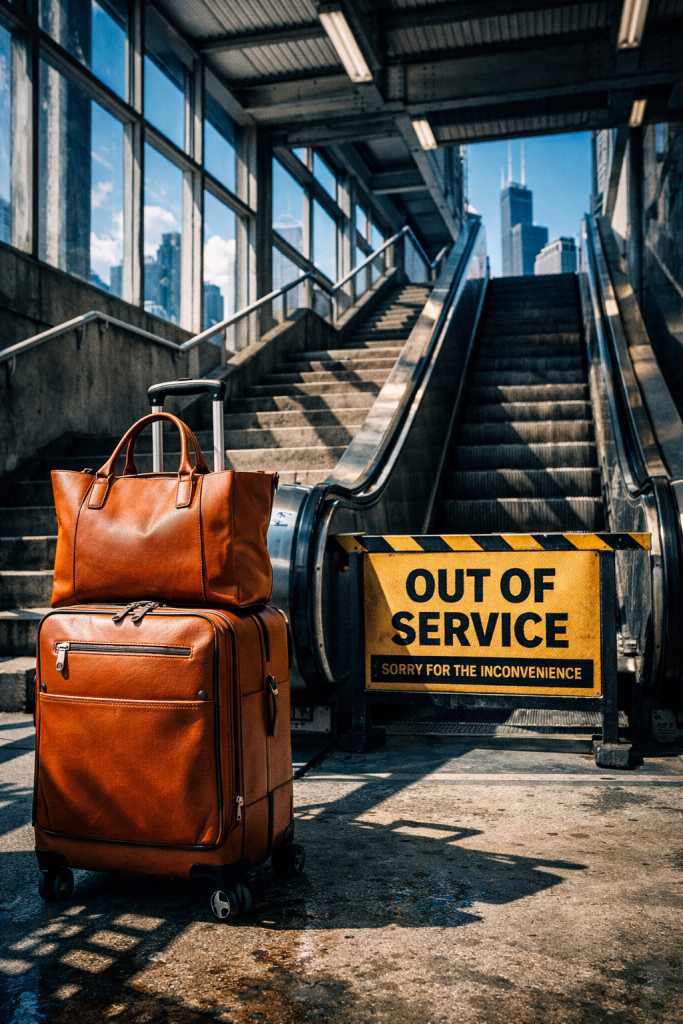
The vision did not account for the broken escalator.
Blue Line, fresh off the plane from O’Hare. Two suitcases. Milestone energy fully activated. I get to my stop and the escalator, the one that was supposed to exist and do its one job, is out of service. I look for the elevator.
Also out of service.
What greets me instead is a staircase. Three flights. Just standing there, completely unbothered by my situation.
And me. And my bags. And my entire body, which took one look at that staircase and immediately filed a complaint.
I looked over at the station booth. Someone was in there. I could just barely make them out through the dusty glass. Present, technically, the way a closed sign is present. No eye contact. No acknowledgment. No “hey, the elevator’s out, here’s what you can do”. Just a person behind a window, doing the bare minimum of existing near a problem they had no intention of solving.
So I carried those bags up every single step. Still trying to play hype-man for myself, one day before my birthday. Still excited to lock eyes with the city.
Somewhere between the first flight and the third, something shifted. I stopped being frustrated and started thinking about every system and signal that had failed to get me here. Because this exact moment, trying not to sweat, or trip over my luggage, or lose my composure, is precisely where design either holds or completely falls apart.
I was the edge case. The person with luggage. The one for whom just take the stairs is not a workaround. It’s a failure made visible, personal, and physical.
Except here’s the thing. I am not actually an edge case.
How many people move through that system with bags, strollers, mobility limitations, equipment? We are not edge cases. We are the user base. We just weren’t centered in the design.
The CTA map shows the elevators. Good instinct. Right idea. But if that elevator has been out for three weeks and there’s no signage until you’ve already committed to the platform, that is not a maintenance problem. That’s a communication failure. A wayfinding failure. A we designed for the happy path and forgot it breaks failure.
And when the one human in the loop isn’t actually in the loop? That’s not just a system failure. That’s a full collapse. Infrastructure failed. Information failed. And the one touchpoint that could have made it human sat behind dusty glass and let it happen.
Three layers. All at once. One day before my birthday.
They surely didn’t ask for my review. But consider this blog a formal submission.
I think about this constantly when I’m building anything.
What’s the broken escalator moment in this design? Not if something fails, but when. Because things fail. Servers go down. Users show up with contexts we never tested for in our perfectly WiFi’d, climate-controlled offices.
The question is never whether your system will face stress. The question is what it does when it does.
Does it warn you before you’ve committed to the wrong path? Does it offer a real alternative or just an apology? Does it treat the person on the staircase like they matter as much as the person who got the working elevator?
Error messages that actually help. Offline states that don’t punish you. Alternative paths that don’t feel like punishment. Support that shows up when things go sideways. Systems built for real life, not the ideal conditions that only exist in a product brief.
That’s the work.
But here’s what I also need to tell you. Milestone birthday stories need the full picture.
I carried those bags. My entire body had opinions. But when I got to the top of that staircase, caught my breath, and looked up, the Windy City just hit me. All of it flooding back at once. A little perspiration, completely in my feelings, smiling at the city after a long awaited reunion.
Home sweet home.
My Chicago broad shoulders reactivated in real time.
I ate at every restaurant on my list. Booked a photoshoot on the lakefront. The wind cooled me off like it always has. I was a full-blown tourist in my own city and loved every single second of it. I carried three flights of stairs and now I know exactly how to navigate around that next time. I tried to make it look easy. Held it together long enough to reach the top. That’s all that matters.
Chicago gave me exactly the gift I needed. A reminder of what I’m here to do.
Design better stairs. Before someone else has to carry the bags.
Whitney Cullens is a product designer who believes the best systems are built by people who’ve had to find their own way around the broken ones.